Executive Answer
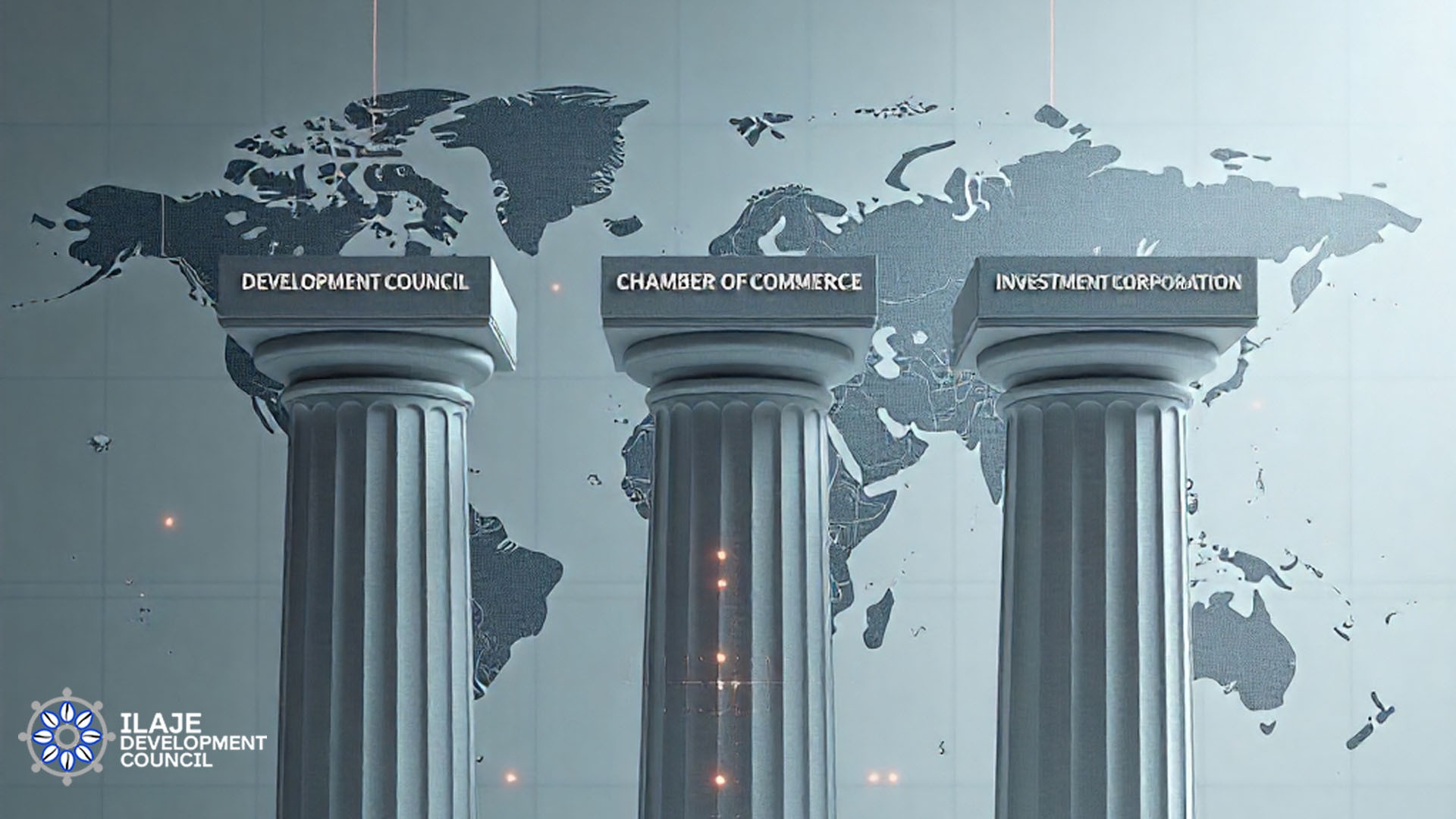
A Development Council provides governance, strategic coordination, and oversight for regional development. A Chamber of Commerce mobilizes businesses, supports trade, and improves enterprise readiness. An Investment Corporation executes projects commercially, deploys capital, and manages assets. Separating these roles reduces risk, improves accountability, and makes regions more attractive to investors and development partners.
Why These Institutions Are Often Confused
In many emerging and developing regions, governance, advocacy, and execution are often combined into a single institution. While this may seem efficient, it can lead to confusion, conflicts of interest, and increased risk, especially for investors and development partners.
A single body may simultaneously claim to:
represent community interests
promote businesses
approve projects
raise capital
execute development
From the outside, this lack of separation signals institutional immaturity. Investors struggle to identify who has authority, who bears risk, and who is accountable when things go wrong.
Clear institutional differentiation solves this problem.
Globally, successful development ecosystems rely on the separation of roles, where governance, enterprise mobilization, and commercial execution are handled and managed by distinct but aligned entities. To grasp how effective regional development operates and works, it is crucial to understand the differences between a Development Council, a Chamber of Commerce, and an Investment Corporation.
What Is a Development Council?
A Development Council is a governance and coordination institution responsible for guiding long-term socio-economic development within a defined region.
It is neither a project developer, contractor, nor investment fund.
Core Functions of a Development Council
Setting development priorities and strategy
Originating and structuring development frameworks
Coordinating stakeholders (community, government, partners)
Providing institutional legitimacy and continuity
Endorsing initiatives that meet governance and strategic criteria
Maintaining oversight and alignment
A Development Council operates as a neutral steward, adding value by reducing fragmentation and bringing various stakeholders together into a shared framework without directly executing projects.
What a Development Council Does Not Do
It does not deploy capital
It does not execute projects
It does not hold commercial assets
It does not pursue profit
From an investor’s perspective, this restraint is a strength. It signals that governance decisions are insulated from commercial pressure and political cycles.
In the Ilaje context, the Ilaje Development Council (IDC) serves as the institutional anchor, providing stewardship, legitimacy, and oversight across the development ecosystem.
What Is a Chamber of Commerce?
A Chamber of Commerce is a business membership and enterprise-support institution. Its primary role is to organize, represent, and strengthen the private sector, particularly local and regional businesses.
Where a Development Council focuses on strategy and governance, a Chamber focuses on business readiness and participation.
Core Functions of a Chamber of Commerce
Representing businesses and entrepreneurs
Supporting trade, market access, and networking
Improving enterprise competitiveness and capacity
Facilitating training, standards, and compliance readiness
Acting as a collective voice for the private sector
Chambers does not set development policy or execute public projects. Instead, they prepare businesses to participate effectively in opportunities created through development frameworks.
In Ilaje, the Ilaje Chamber of Commerce & Industry (ICCI) plays this supply-side role, mobilizing enterprises so that local businesses are positioned to benefit from and contribute to structured development initiatives.
What Is an Investment Corporation?
An Investment Corporation is a commercially structured entity responsible for executing projects, deploying capital, and managing assets.
This is where:
Capital is raised
Risk is taken
Returns are generated
Projects are delivered
Unlike a Development Council or a Chamber of Commerce, an Investment Corporation operates on commercial terms.
Core Functions of an Investment Corporation
Executing approved development projects
Structuring joint ventures and partnerships
Mobilizing domestic and foreign capital
Holding equity and managing assets
Ensuring professional project delivery
An Investment Corporation may be public, private, or mixed, but its defining feature is that it bears execution and financial risk.
In Ilaje’s framework, the Ilaje Investment Corporation (IIC) will be activated as a standalone commercial entity once foundational projects demonstrate bankability. Until then, execution is managed through a ring-fenced commercial unit within IDC governance.
How the Three Work Together (The Three-Engine System)
The strength of this model lies not in any single institution, but in how they interact without overlapping roles.
Think of the system as three engines operating in sequence:
Governance & Stewardship (Development Council)
Defines priorities
Structures frameworks
Aligns stakeholders
Endorses initiatives
Business Mobilization (Chamber of Commerce)
Prepares enterprises
Improves competitiveness
Enables local participation
Commercial Execution (Investment Corporation)
Delivers projects
Deploys capital
Manages assets and risk
Each engine does one job well. None substitutes for the others.
This separation:
prevents conflicts of interest
improves accountability
allows each institution to specialize
creates clarity for investors and partners
Most importantly, it ensures that governance remains neutral while execution remains commercial.
Why This Separation Matters to Investors
Investors do not simply assess projects—they assess systems.
When governance, advocacy, and execution are blurred, investors face:
unclear authority
political interference
weak accountability
elevated non-market risk
By contrast, a separated institutional model provides:
predictable decision-making
clear risk allocation
professional execution pathways
institutional continuity
For long-term investors, this clarity often matters more than incentives or promotional messaging.
A Development Council that does not execute projects is not weak—it is credible.
Ilaje in Context: Applying the Model Locally
Ilaje’s coastal region presents multi-sector development opportunities, but also complex stakeholder dynamics involving communities, government entities, businesses, and investors.
Rather than collapsing these interests into a single body, Ilaje’s development framework deliberately separates roles:
IDC provides governance, origination, and oversight
ICCI mobilizes and prepares local enterprises
IIC executes projects commercially
This approach allows Ilaje to pursue development that is:
community-informed
institutionally governed
commercially viable
It signals seriousness to partners and discipline to investors—before any project is promoted.
Key Takeaways
A Development Council governs and coordinates development—it does not execute projects
A Chamber of Commerce strengthens businesses and enables trade
An Investment Corporation executes projects and deploys capital
Separating these roles reduces risk and improves credibility
Ilaje’s Three-Engine system aligns governance, enterprise readiness, and execution without overlap
Clear institutions build trust. Trust enables investment.
IDC-Appropriate CTA
Learn how governance-led development frameworks reduce risk and support sustainable regional growth.
→ Explore the Ilaje Development Council Knowledge Base